Fysio Huis
Zhenya (Guy) Horowitz
Founder & Manual Therapist – Physio House
On 1 March 2026, Physio House marks TEN YEARS!
To everyone who’s been part of it—and to those yet to come—here’s what I want to say:
Physio House was not something I planned years in advance. It grew slowly—through work, responsibility, and repetition.
I didn’t originally aim to become a physiotherapist, and owning a clinic was never a clear goal. After a few academic detours, physiotherapy was a practical choice.
Meaning came later. Only after years of treating pain, injury, and limitation did I begin to understand the profession—and myself—more clearly.
I lived and worked in several countries before completing a Master’s degree in Manual Therapy (SOMT, Netherlands). Along the way, I treated a wide range of people: elite athletes, complex cases, and individuals simply trying to move better and live with less pain. One thing became clear early on—recovery is rarely linear. People don’t simply “go back to normal.” With the right guidance, many become stronger, more aware, and more capable than before. That idea still guides my work: physiotherapy not only as rehabilitation, but as a form of post-traumatic growth.
Physio House was founded in 2016 as a reflection of how I work. The approach is simple: restore capacity, build strength, and remove what is unnecessary. I don’t see stress as something to avoid, but something to apply carefully. When done well, it builds resilience. Less dependency, more responsibility. Fewer promises, better outcomes.
My background as an athlete strongly shapes this view. I come from MMA and powerlifting, and I believe strength training is a baseline for a healthy life.
Strength creates options—physically and mentally. Much of the work in the clinic is built around that principle.
Treatment combines solid physiotherapy with attention to the psychosomatic side of recovery. The body responds not only to load and movement, but also to mental state, history, and context. Ignoring that usually slows progress.
The clinic itself evolved naturally. It is calm, personal, and intentionally small. There is a lounge, a strength gym with carefully chosen equipment (Eleiko, Rogue, Kabuki, Exxentrics), and music playing quietly in the background—blues, jazz, classical, older pop. Nothing is there by accident. The space is meant to slow things down and help people settle.
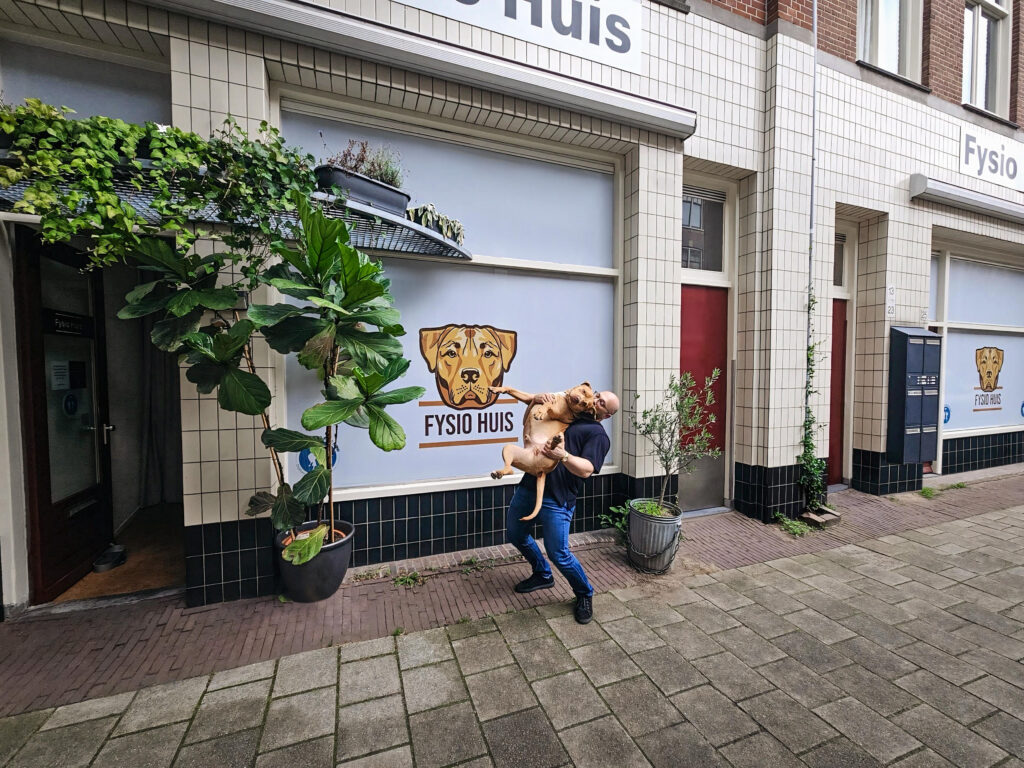
Kafka, my dog, became part of the clinic almost by coincidence. I picked him as a puppy without much thought, not knowing how much he would shape my daily life. Over time, he became part of the rhythm of the clinic—present, calm, observant. Patients notice him immediately. His face eventually became the clinic’s logo, and somehow he turned into one of the most recognised dogs in Amsterdam. More importantly, he brings steadiness into the space. Dogs are honest. They don’t rush, and they don’t pretend. That helps.
My work is shaped by study, by sport, by my own injuries, and by watching how people actually recover over time. I continue to learn from every patient.
When I believe someone would benefit more from another professional, I refer openly. Outcomes matter more than ownership.
Physio House remains small by choice. A larger, more standardised clinic could reach more people, but depth would be lost. I accept that trade-off consciously.
I prefer fewer patients, better attention, and work that I can stand behind.
This year marks ten years of Physio House, and the meaning is straightforward: a decade of showing up, welcoming thousands of individual stories, and improving the craft without lowering the standard. Welcoming every experience is how you keep growing—because each one shows you something real about yourself: your edges, your values, your blind spots, your strength. In our profession, that becomes tangible. You’re not only meeting bodies and symptoms; you’re meeting people—often in vulnerable moments.
A late friend of mine—a psychiatrist—once said:
“This place feels like no other place I’ve seen, and it’s exactly you!”
Alongside the clinic, I founded Care for Kids Now, which provides direct support to orphanages and children affected by war and trauma in Ukraine. That work keeps my perspective grounded beyond the walls of the clinic. Those who wish to learn more or support it can visit careforkidsnow.org.
The Prices
Fysio Huis is affiliated with all Dutch health insurers. If you are insured for physiotherapy, I will declare it directly to your health insurer. If you are not insured, you can pay by debit card after your treatment. Since 2006 it is no longer necessary to have a referral letter from the general practitioner.
Intake: € 65,-
Treatment: € 65,-
Personal Training: € 110,-
Cancellation Policy:
Fully charged if cancelled in less than 24 hours in advance. Your health insurer does not reimburse these costs.
Reviews


Winner Strongman
The Ice Man
The Mad Scientist of Strength

